
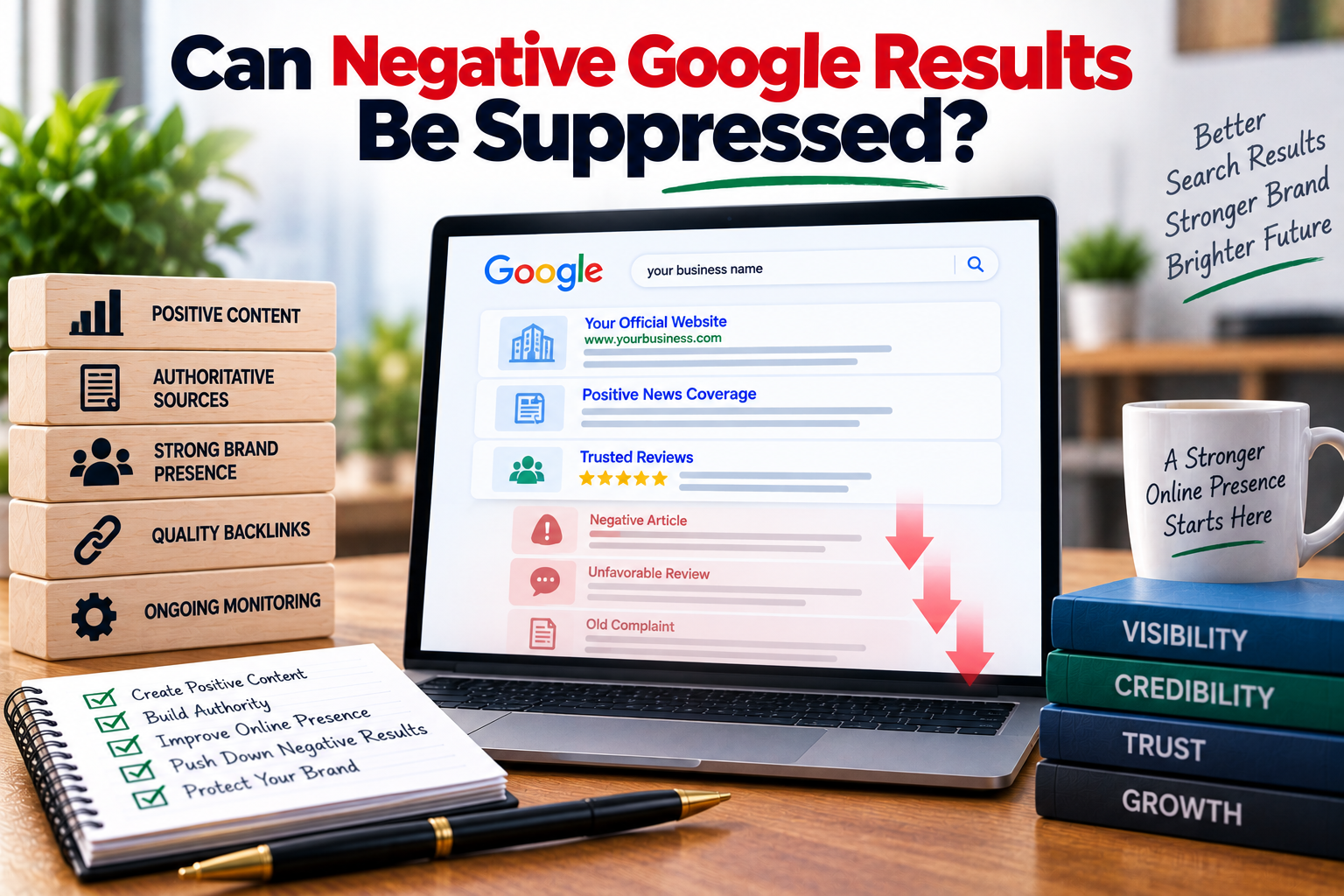
A negative Google result can influence how people perceive a person or business before they ever make contact.
Someone may search a company name and find a critical article. A potential customer may discover an old complaint. A prospective partner may see an unfavorable review. An outdated page may appear prominently even though the situation described on it has changed.
When direct removal is not available, many people ask whether the negative result can be suppressed.
Yes, negative Google results can sometimes be suppressed through legitimate search visibility and reputation management strategies.
However, suppression is not the same as removal.
Removal attempts to take eligible content down from its source or prevent it from appearing in search results under an applicable policy.
Suppression focuses on strengthening other relevant and legitimate content so that unwanted results become less prominent.
Understanding this difference is important when developing an online reputation strategy.
What Is Negative Google Result Suppression?
Negative result suppression is a reputation management approach designed to reduce the visibility of unwanted search results.
The original webpage may remain online.
Instead of trying to delete it, the strategy focuses on creating, improving, and promoting legitimate content that deserves to rank for the same or related searches.
For example, a business may strengthen its official website, publish useful industry resources, maintain professional profiles, develop company pages, and earn credible third party coverage.
The goal is to give search engines more useful and authoritative content to display.
Why Do Businesses Suppress Negative Results?
Businesses may consider suppression when negative content is:
Legitimate
Difficult to remove
Published by a third party
Newsworthy
Protected by editorial policies
Not covered by a search removal policy
No longer representative of the company
A single negative result may not tell the full story.
Suppression can help create a broader search presence that provides people with more accurate context.
Is Suppression the Same as Removing a Result?
No.
This is one of the most important distinctions.
Removal means the original content is deleted or a search engine stops displaying eligible content under a relevant removal process.
Suppression means the content remains available but becomes less prominent because other relevant pages perform better in search results.
If an article is removed from its source website, it may eventually disappear from search results.
If an article is suppressed, it can still exist and may be found through other searches or direct access.
Can Google Results Actually Be Suppressed?
Search rankings can change when other pages become more relevant, authoritative, useful, or competitive for a search query.
No one outside Google can directly control its ranking system.
There is also no legitimate way to guarantee that a particular negative result will remain permanently below a specific position.
However, businesses can improve their own digital assets and publish legitimate content that may compete for visibility.
This is the foundation of search result suppression.
What Types of Negative Results Can Be Suppressed?
Potentially, many types of unwanted content can become less prominent.
Examples include:
Negative articles
Old complaints
Unfavorable business pages
Negative reviews
Forum discussions
Critical blog posts
Outdated profiles
Negative media coverage
Third party pages
The ability to suppress a result depends on the search query, the strength of the negative page, the available positive or neutral content, and the competitiveness of the search results.
Step 1: Audit the Search Results
The first step should always be research.
Search the exact business name.
Search variations of the company name.
Search the names of important products or services.
Review the first few pages of results.
Look at images and other search features.
Identify every result that creates a reputation concern.
Record the URL, title, website, ranking position, and type of content.
This provides a baseline for measuring progress.
Step 2: Classify Each Negative Result
Not every negative result should be handled in the same way.
Separate results into categories.
For example:
Content that may qualify for removal
Content that may qualify for correction
Legitimate negative content
Outdated content
Fake reviews
Neutral content
Low quality pages
This classification helps determine whether removal, correction, reporting, or suppression is the most appropriate option.
Step 3: Try Legitimate Removal First
Suppression should not replace removal when genuine removal is available.
If an article contains demonstrably false information, contact the publisher.
If a review violates platform policies, report it.
If a page exposes eligible personal information, investigate the relevant removal process.
If the source website removes the content, search engines may eventually update their results.
Only content that has a legitimate basis for removal should be targeted.
Step 4: Strengthen Your Official Website
Your official website is one of the most important assets in a search reputation strategy.
Make sure it clearly communicates:
Who you are
What you offer
Where you operate
Your expertise
Your company history
Your services
Your achievements
Useful resources
Contact information
A weak website provides fewer opportunities for your own content to appear prominently.
A strong website can become an important source of authoritative information about your business.
Step 5: Publish Useful Content
Creating content solely to manipulate search results is not a sustainable strategy.
Instead, publish material that genuinely helps your audience.
Examples include:
Industry guides
Frequently asked questions
Research
Case studies
Educational articles
Company updates
Expert insights
Service explanations
Customer resources
Useful content can strengthen your online presence while providing real value.
Step 6: Build Relevant Business Profiles
Professional business profiles can provide additional sources of information about your company.
Depending on your industry, this may include:
Business directories
Professional organizations
Industry platforms
Company databases
Social profiles
Review platforms
Partner pages
The goal should be relevance and credibility.
Creating dozens of weak profiles simply to occupy search results can create a low quality digital footprint.
Step 7: Develop Positive Brand Assets
Brand assets are online properties that accurately represent the company.
These can include:
Official websites
Company profiles
Founder profiles
Product pages
Knowledge resources
Social media accounts
Industry profiles
Media coverage
The more useful and credible assets a business has, the more opportunities it may have to appear for branded searches.
Step 8: Earn Legitimate Third Party Coverage
Independent coverage can strengthen a company’s digital presence.
This may include interviews, industry articles, expert commentary, business publications, podcasts, events, and other legitimate media opportunities.
Third party coverage can provide additional context about the business.
However, the quality and relevance of the publication matter.
A large collection of low quality pages is not necessarily better than a smaller number of credible resources.
Step 9: Strengthen Existing Pages
Suppression does not always require creating new pages.
Existing pages may already have useful information but lack visibility.
Review important company pages.
Improve the content.
Make the information clearer.
Add relevant details.
Ensure the pages are accessible to search engines.
Connect related pages through logical internal links.
The objective is to make useful content stronger and easier to understand.
Step 10: Build a Consistent Brand Presence
Search engines use many signals to understand entities, websites, and topics.
Businesses should maintain consistent information across important online properties.
Use the correct business name.
Keep descriptions accurate.
Maintain consistent contact information.
Keep profiles updated.
Link relevant official properties where appropriate.
Consistency can help create a clearer digital identity.
Step 11: Manage Genuine Reviews
Reviews can occupy valuable search real estate.
A business should encourage genuine customers to leave honest feedback.
Respond to legitimate complaints professionally.
Report reviews that genuinely violate platform rules.
Do not buy fake reviews.
Do not create fake customer accounts.
Do not manipulate ratings.
Authentic feedback creates a stronger and more sustainable reputation.
Step 12: Create Content Around Your Brand
Branded searches can include more than the exact company name.
People may search:
Company name reviews
Company name services
Company name founder
Company name products
Company name complaints
Company name alternatives
Company name location
Understanding these search patterns can help a business create useful content that answers genuine questions.
The content should provide information rather than simply repeat promotional statements.
Step 13: Monitor Search Rankings
Suppression requires measurement.
Record where important pages appear before implementing a strategy.
Then monitor changes over time.
Track:
Negative URLs
Official website pages
Business profiles
Articles
Reviews
Branded searches
Important related queries
Ranking changes
Search visibility can fluctuate, so progress should be evaluated over a meaningful period rather than based on one day’s results.
How Long Does Suppression Take?
There is no fixed timeframe.
Some changes may occur relatively quickly.
Competitive search results may take considerably longer.
The process depends on:
The authority of the negative page
The strength of competing content
Search competition
The number of available assets
Content quality
Website authority
Search intent
The effectiveness of the overall strategy
Suppression is usually a longer term process rather than an instant solution.
Can One Company Guarantee Suppression?
No.
Google controls its search algorithms.
A company can optimize legitimate content and build a stronger digital presence, but it cannot guarantee that Google will rank a specific page at a specific position indefinitely.
Be cautious of services promising guaranteed first page removal.
Professional reputation management should explain what actions are being taken and what outcomes are realistically possible.
What If the Negative Result Is a Legitimate News Article?
A legitimate news article may be difficult or impossible to remove.
If it contains inaccurate information, contact the publisher and request a correction.
If it is accurate and still relevant, removal may not be appropriate.
In that situation, suppression may be a more realistic approach.
Develop useful content that provides current information about the business and strengthens its broader search presence.
Can Negative Reviews Be Suppressed?
Potentially, but businesses should not attempt to manipulate review platforms.
First determine whether the review violates platform policies.
If it does, report it.
If it is legitimate, respond professionally.
A stronger base of authentic reviews can help provide customers with a more balanced view.
Other legitimate business pages can also contribute to the overall search presence.
Can Old Negative Content Be Suppressed?
Yes, potentially.
Older content may become less prominent as newer, more relevant content is published and strengthened.
However, age alone does not guarantee that an old page will disappear.
A highly authoritative article can remain visible for years.
The strategy should focus on building stronger and more useful alternatives.
What Should You Avoid During Suppression?
Avoid shortcuts that can create additional problems.
Do not create fake websites.
Do not publish fake reviews.
Do not generate large amounts of meaningless content.
Do not use misleading claims.
Do not manipulate users.
Do not create fake media coverage.
Do not build networks of low quality websites solely to manipulate rankings.
Long term reputation management should be based on legitimate digital assets and useful information.
Why Monitoring Matters After Suppression
A successful reputation strategy should continue after unwanted results become less visible.
Search results can change.
New articles can appear.
A customer can publish a complaint.
A review can suddenly receive attention.
An old page can become relevant again.
Ongoing monitoring allows businesses to identify new risks early.
Final Thoughts
Negative Google results can sometimes be suppressed, particularly when direct removal is unavailable.
The process begins with a detailed search audit.
Identify the unwanted results.
Determine whether any qualify for legitimate removal.
Request corrections where appropriate.
Report genuine policy violations.
Then strengthen your official website, publish useful content, maintain credible profiles, build legitimate third party coverage, and develop a consistent online presence.
Suppression is not about deleting history or hiding legitimate information.
It is about improving the quality and visibility of the information people find when they search for a business or individual.
Results cannot be guaranteed, and no legitimate provider controls Google’s ranking system.
However, a thoughtful and ethical reputation strategy can help create a stronger search presence and make unwanted results less prominent over time.
Frequently Asked Questions
Can negative Google results be suppressed?
Yes, negative results can sometimes become less prominent when stronger, more relevant, and legitimate content gains visibility for the same searches.
Is Google result suppression the same as removal?
No. Removal attempts to delete or deindex eligible content. Suppression focuses on strengthening other content so the unwanted result becomes less visible.
Can a negative article be suppressed?
Potentially. If legitimate removal or correction is unavailable, relevant and authoritative content can be developed to compete for visibility.
How long does Google suppression take?
There is no fixed timeframe. Results depend on the strength of the negative page, competing content, search competition, and the overall reputation strategy.
Can fake reviews be suppressed?
Businesses should first report reviews that genuinely violate platform policies. For legitimate negative reviews, professional responses and authentic customer feedback are more appropriate.
Can a legitimate news article be suppressed?
Potentially. If the article cannot legitimately be removed, strengthening relevant and accurate content may help reduce its prominence.
Can I guarantee that a negative result will disappear?
No. Google controls its search algorithms, so no legitimate provider can guarantee a permanent ranking position or removal.
What is the first step in negative result suppression?
Conduct a search reputation audit. Identify the negative URLs, their rankings, the websites hosting them, and the searches for which they appear.
Should I remove negative content before suppressing it?
If content genuinely qualifies for removal, removal should generally be considered first. Suppression is more relevant when legitimate removal is unavailable.
Can SEO help suppress negative results?
Legitimate search optimization can help improve the visibility of relevant content. Reputation suppression typically combines content development, website improvements, digital assets, and other visibility strategies.
Can a business suppress negative Google reviews?
A business cannot simply force legitimate reviews out of search results. It can report policy violations, respond professionally, encourage genuine feedback, and strengthen its broader online presence.
Can old negative results be suppressed?
Yes, potentially. Newer and more relevant content may become more prominent, although there is no guarantee that old content will disappear.
Does creating more content guarantee suppression?
No. Content quality, relevance, authority, search intent, and competition all influence visibility. Publishing large amounts of low quality content is unlikely to provide a sustainable solution.
Can reputation management companies suppress Google results?
They can assist with search audits, content strategy, digital reputation management, monitoring, and other legitimate visibility activities. They cannot directly control Google’s rankings.
Is negative result suppression permanent?
It cannot be guaranteed to remain permanent. Search rankings change, and new content can appear at any time.
What happens if a suppressed result returns?
Review the search results again, identify what changed, strengthen relevant content, and determine whether the returning page qualifies for removal or correction.
Can suppression remove a webpage from the internet?
No. Suppression generally affects search visibility rather than deleting the original webpage.
Should businesses buy links to suppress negative results?
Businesses should avoid manipulative link schemes and focus on legitimate, relevant digital assets and credible sources.
How can I protect my search reputation after suppression?
Continue monitoring search results, maintain accurate online profiles, publish useful content, manage reviews professionally, and address new reputation issues early.
What is the difference between reputation management and suppression?
Online reputation management is the broader process of monitoring and improving a digital reputation. Search result suppression is one strategy that can be used when unwanted content remains online.

Leave a Reply